Over the last couple of days we have begun a series of lectures on the gospel of Matthew presented by an Italian priest Father Pino Di Luccio. We have looked at the early parts of the Gospel including the genealogy of Jesus, the birth story and the baptism of Jesus. We have learnt lots about the identity of Jesus and his relationship to John the Baptist, as well as the many ways He fulfills the prophesies of the Old Testament. While it is often heavy going, it is still really interesting.
Yesterday afternoon, a small group of us went to the Armenian Church - St. James Cathedral, for their vespers prayers with their seminarians. The Armenians have been in the Holy Land since the earliest years of Christianity and they were the first nation to adopt Christianity as a state religion. As early as 154CE, the bishops of Armenia were involved in discovering and confirming many of the Holy sites.
3pm Vespers is the only time non- Armenians are allowed into the Armenian Quarter. The church was very dark with lots of silver oil lamps and painted icons on the wall that were covered and dark from all the incense used in their liturgies. There was lovely singing, prayers and incense being burnt. In one of the side chapels is a shrine where the head of St . James the apostle is said to be entombed. St. James was also the first bishop of Jerusalem.
This afternoon we had a visiting lecturer tell us all about the Dead Sea and the Dead Sea Scrolls- we are heading there tomorrow for a float ( the Dead Sea is 35% salt!) and a look around - I am really looking forward to this next adventure!

Friday, 14 September 2012

Thursday, 13 September 2012
Once in Royal David's City .........
Most mornings a group of us meet together for prayer and meditation before breakfast. Yesterday morning, in preparation for our visit to Bethlehem, Drasko led us in a meditation on the incarnation. He taught us St. Simeon's meditation where you focus on each part of your body, hands, limbs, organs etc and say for each part - "This is Christ's hand/heart etc - a very powerful meditation exercise.
We left early for Bethlehem, passing through the checkpoint around 8am, which meant we arrived at the Church of the Nativity early when there were no other tourists. The entry to the church is via a small doorway that the Crusaders put in to stop people entering with horses and carts. It is a large church with lots of lamps hanging from the ceiling with Christmas baubles on them and many icons painted on the large columns. It also has a wooden roof and a beautiful mosaic floor which had only been discovered relatively recently.
We waited for a mass to finish the we were hurried in to see the grotto of the nativity that has a silver star under an altar to mark the spot where Jesus is said to have been born. With people speaking and telling us to rush through quickly, it was very difficult to feel a sense of peace and joy one should feel at visiting such a sacred place!
We then went underground to the cave at the back of the grotto where they believe Mary and Joseph entered so Mary could give birth in private. We also saw the tombs of the Holy Innocents - the children who were killed by Herod after the birth of Jesus. We also visited St. Catherine's Church which had some lovely stained glass windows.
After this, we walked up the street to meet Sister Maria from the Franciscan Family Centre to hear about the amazing work she is doing for families in the area through counseling and building projects, as well as a boys' home. The four sisters in her congregation are doing an incredible job assisting and empowering the local people - inspirational!
We then travelled by bus to the Shepherd's Fields where it is believed the shepherds saw the angels who heralded the birth of Jesus. Here we went into one of the cave chapels where Rico, one of our pilgrim priests, celebrated a beautiful mass for us.
We had a traditional lunch in a nearby restaurant before going to Bethlehem University, which has been run by the De La Salle brothers for the last 40 years. We first visited their chapel - dedicated to children. The stained glass windows depicted scenes from the childhood of Jesus - my favorite was one of him playing with blocks at the foot of Mary. The walls were covered in paintings of all the children martyrs from around the world.
We then heard from Brother Peter about the three main goals of the university:
• to provide an oasis of peace for the students
• to be a beacon of hope for the people
• to provide high quality education.
The university is having a huge impact. for students and the whole community. and has been recognized by the Pope and others for what it is providing for its students. This visit was an unexpected yet wonderful addition to our visit to Bethlehem.


We left early for Bethlehem, passing through the checkpoint around 8am, which meant we arrived at the Church of the Nativity early when there were no other tourists. The entry to the church is via a small doorway that the Crusaders put in to stop people entering with horses and carts. It is a large church with lots of lamps hanging from the ceiling with Christmas baubles on them and many icons painted on the large columns. It also has a wooden roof and a beautiful mosaic floor which had only been discovered relatively recently.
We waited for a mass to finish the we were hurried in to see the grotto of the nativity that has a silver star under an altar to mark the spot where Jesus is said to have been born. With people speaking and telling us to rush through quickly, it was very difficult to feel a sense of peace and joy one should feel at visiting such a sacred place!
We then went underground to the cave at the back of the grotto where they believe Mary and Joseph entered so Mary could give birth in private. We also saw the tombs of the Holy Innocents - the children who were killed by Herod after the birth of Jesus. We also visited St. Catherine's Church which had some lovely stained glass windows.
After this, we walked up the street to meet Sister Maria from the Franciscan Family Centre to hear about the amazing work she is doing for families in the area through counseling and building projects, as well as a boys' home. The four sisters in her congregation are doing an incredible job assisting and empowering the local people - inspirational!
We then travelled by bus to the Shepherd's Fields where it is believed the shepherds saw the angels who heralded the birth of Jesus. Here we went into one of the cave chapels where Rico, one of our pilgrim priests, celebrated a beautiful mass for us.
We had a traditional lunch in a nearby restaurant before going to Bethlehem University, which has been run by the De La Salle brothers for the last 40 years. We first visited their chapel - dedicated to children. The stained glass windows depicted scenes from the childhood of Jesus - my favorite was one of him playing with blocks at the foot of Mary. The walls were covered in paintings of all the children martyrs from around the world.
We then heard from Brother Peter about the three main goals of the university:
• to provide an oasis of peace for the students
• to be a beacon of hope for the people
• to provide high quality education.
The university is having a huge impact. for students and the whole community. and has been recognized by the Pope and others for what it is providing for its students. This visit was an unexpected yet wonderful addition to our visit to Bethlehem.
Tuesday, 11 September 2012
Tunneling through time
An early start today - we headed to the Western Wall at 7am to go under the wall on a tunnel tour. There were different scenes at the Wall this morning with many of the men wearing white prayer shawls and the tefillin - special boxes containing the words of the Shema which they strap to their heads and arms as instructed in the Torah. There were also large boxes or arks containing the scrolls of the Torah.
Inside the tunnels we learnt about the history of the Temple mount - a sacred mountain for Jews, Christians and Muslims. We also walked along the underground part of the Western Wall and passed some women praying at the part closest to where the Holy of Holies would have been - the most sacred site for the Jewish people.
We then walked outside the walls to the city of David, part of the ancient city of Jerusalem. Here we saw ancient excavations and walked on old roman roads but the highlight was walking through a water tunnel created by hezekiah to protect the water supply in case of an invasion. We also stood on a Roman street where there was a marketplace next to the temple - which could be the place where Jesus got angry with the people.
After the tour we went up the hill to the church of St. Peter in Gallicantu - believed to be the site of Caiphas' house where Peter denied Jesus and the cock crew. The crypt was beautiful and below that was the dungeon where Peter was probably held.
In the evening we went on a tour of the basement of our own home here in Jerusalem. "Ecce Homo" means here is the man and the basement is believed to be where Pilate presented Jesus to the Jews after being crowned with thorns. There is an original Roman road under us which was likely to have been where this occurred - just amazing!
This was another wonderful day - a walk into the depths of the Jerusalem in the time of Jesus and before. It is so hard to take in all the history - there is so much to learn!


Inside the tunnels we learnt about the history of the Temple mount - a sacred mountain for Jews, Christians and Muslims. We also walked along the underground part of the Western Wall and passed some women praying at the part closest to where the Holy of Holies would have been - the most sacred site for the Jewish people.
We then walked outside the walls to the city of David, part of the ancient city of Jerusalem. Here we saw ancient excavations and walked on old roman roads but the highlight was walking through a water tunnel created by hezekiah to protect the water supply in case of an invasion. We also stood on a Roman street where there was a marketplace next to the temple - which could be the place where Jesus got angry with the people.
After the tour we went up the hill to the church of St. Peter in Gallicantu - believed to be the site of Caiphas' house where Peter denied Jesus and the cock crew. The crypt was beautiful and below that was the dungeon where Peter was probably held.
In the evening we went on a tour of the basement of our own home here in Jerusalem. "Ecce Homo" means here is the man and the basement is believed to be where Pilate presented Jesus to the Jews after being crowned with thorns. There is an original Roman road under us which was likely to have been where this occurred - just amazing!
This was another wonderful day - a walk into the depths of the Jerusalem in the time of Jesus and before. It is so hard to take in all the history - there is so much to learn!
Sunday, 9 September 2012
Getting to know our neighborhood.
This morning we got up early and went to the 6.30am Mass at the Church of the Holy Sepulchre. The Mass was said and sung in Latin and was celebrated just outside the tomb where Jesus was buried and where He rose again. Even though we couldn't understand much at all, the singing by the Franciscan monks was lovely and it was very moving. Afterwards we got to spend a few moments in quiet prayer both in the tomb itself and at the site of the crucifixion - Golgotha. We also found an ancient tomb carved into the rock, as well as a lovely side chapel that had the most beautiful stations of the cross done in small statues.
We went back to Ecce Homo for breakfast then headed to the Mount of Olives. We stumbled on an interesting church which we discovered later was the tomb of Mary. We walked down stairs into the church which was very old and decorated with hanging lamps. There was an orthodox mass being said by a Bishop and there were lots of people involved including an amazing all male choir whose singing was haunting.
Next door, we found the grotto of Gethsemane where Jesus was betrayed by Judas, and near that was the Garden of Gethsemane which contained some ancient olive trees.
We then walked up the hill past the Jewish cemetery which contains the remains of 180,000 Jews who believed that all mankind would be resurrected on the Day of Judgment from this spot.
We continued further up the hill to the Dominus Flevit Chapel which had an amazing view out of its window across to the Dome of the rock and the Old City. We got to the top of the mount of Olives and had a picnic lunch while enjoying the stunning view across the city.
In the afternoon we went on a very informative tour of the four quarters of the city - the Muslim, Christian, Armenian and Jewish Quarters. We learnt how these different cultures and religions live side by side in this tiny city which is only one square kilometer in size. Some of the interesting facts we learnt included:
• of the 37,000 people living in the old city, 27,000 are Muslim, 5,000 are Christian, 2,000 are Armenian and only 2,500 are Jewish
• the Armenian Quarter is walled in by a double wall and they do not mix much with the other people
• many of the Christian holy sites are in the Muslim quarter.
This tour taught us the importance of looking beyond the historical and religious sites to see and get to know the people in this special place.
Even though this was a tiring day, it was one of the best days of our stay so far for me! I saw, learnt and experienced so much! And there is still so much more to come!


We went back to Ecce Homo for breakfast then headed to the Mount of Olives. We stumbled on an interesting church which we discovered later was the tomb of Mary. We walked down stairs into the church which was very old and decorated with hanging lamps. There was an orthodox mass being said by a Bishop and there were lots of people involved including an amazing all male choir whose singing was haunting.
Next door, we found the grotto of Gethsemane where Jesus was betrayed by Judas, and near that was the Garden of Gethsemane which contained some ancient olive trees.
We then walked up the hill past the Jewish cemetery which contains the remains of 180,000 Jews who believed that all mankind would be resurrected on the Day of Judgment from this spot.
We continued further up the hill to the Dominus Flevit Chapel which had an amazing view out of its window across to the Dome of the rock and the Old City. We got to the top of the mount of Olives and had a picnic lunch while enjoying the stunning view across the city.
In the afternoon we went on a very informative tour of the four quarters of the city - the Muslim, Christian, Armenian and Jewish Quarters. We learnt how these different cultures and religions live side by side in this tiny city which is only one square kilometer in size. Some of the interesting facts we learnt included:
• of the 37,000 people living in the old city, 27,000 are Muslim, 5,000 are Christian, 2,000 are Armenian and only 2,500 are Jewish
• the Armenian Quarter is walled in by a double wall and they do not mix much with the other people
• many of the Christian holy sites are in the Muslim quarter.
This tour taught us the importance of looking beyond the historical and religious sites to see and get to know the people in this special place.
Even though this was a tiring day, it was one of the best days of our stay so far for me! I saw, learnt and experienced so much! And there is still so much more to come!
Saturday, 8 September 2012
A Desert Experience
We got off to an early start this morning with a packed lunch and plenty of water as we headed 20 kilometers out of Jerusalem to the Judean desert with our lovely Jewish guide Jared. The first lookout we stopped at gave us a lovely panoramic view of the rocky limestone hills and cliffs - no sandy dunes here! We then headed down the valley where we began our walk. It was amazing to think that this was the area where Jesus spent forty days and where Moses led the Israelites to the Promised land. The other amazing thing was that there was a fast flowing spring in the middle of the desert - which created a beautiful river with fish and lush green vegetation. I even went for a swim- something I never thought I would do in a desert!
The morning was quite challenging with rocks to climb up, water to wade through, thistles to avoid and steep hills to conquer- a symbolic reflection on life itself with all its ups and downs, obstacles and blessings, like the refreshing water of the river!
Our guide told us about how the Jews see the desert as hefker - a state of ownerless. He asked us to think about the burdens, commitments and distractions in our life- work, technology etc and asked us, in the silence of the desert to try to make ourselves hefker - a person who is free and not owned by anyone or anything.
The desert experience was a tiring yet moving one for me - out there all you have is yourself - money, statusetc mean nothing. You are there in the midst of God's creation and vulnerable to the elements especially the intense heat. I learnt so much from this experience about myself, others and God.
After a recovery afternoon, we walked down to the western Wall - the most sacred place for Jews as it is the last remaining wall of the temple and the Jews believe it is the closest place to God - to see the Jewish people praying just before the Shabbat - Sabbath. There is a separate section of the wall for the men and another for the women. We went down to the women's section where we could go right up to and touch the wall. I placed a prayer in the cracks of the wall and said a prayer. We noticed the ladies coming back from the wall were walking in reverse so they did not turn their back to the wall. The women were very emotional and prayed from a prayer book and rocked as they prayed. The men did the same. It was very interesting to observe these people as they worshipped and prayed to their God.


The morning was quite challenging with rocks to climb up, water to wade through, thistles to avoid and steep hills to conquer- a symbolic reflection on life itself with all its ups and downs, obstacles and blessings, like the refreshing water of the river!
Our guide told us about how the Jews see the desert as hefker - a state of ownerless. He asked us to think about the burdens, commitments and distractions in our life- work, technology etc and asked us, in the silence of the desert to try to make ourselves hefker - a person who is free and not owned by anyone or anything.
The desert experience was a tiring yet moving one for me - out there all you have is yourself - money, statusetc mean nothing. You are there in the midst of God's creation and vulnerable to the elements especially the intense heat. I learnt so much from this experience about myself, others and God.
After a recovery afternoon, we walked down to the western Wall - the most sacred place for Jews as it is the last remaining wall of the temple and the Jews believe it is the closest place to God - to see the Jewish people praying just before the Shabbat - Sabbath. There is a separate section of the wall for the men and another for the women. We went down to the women's section where we could go right up to and touch the wall. I placed a prayer in the cracks of the wall and said a prayer. We noticed the ladies coming back from the wall were walking in reverse so they did not turn their back to the wall. The women were very emotional and prayed from a prayer book and rocked as they prayed. The men did the same. It was very interesting to observe these people as they worshipped and prayed to their God.
Friday, 7 September 2012
Celebrating sisterhood
Yesterday began with an introduction to Judaism with a wonderful and engaging Jewish lady called Debbie. She shared four main points about Judaism:
• It is important to remember that Jesus, Mary the early disciples and gospel writers were all Jews- so it is important for Christians to learn about the roots of our faith to be found in Judaism
• Ancient and modern Judaism are connected so today's Jews are a link in the chain to the past
• Jews are not exclusively and primarily a religious group - they are a people hood.
• Jews are a people who argue a lot - there is very little they agree on.
I thoroughly enjoyed her lectures and learnt some much about the Jewish culture of the past and today.
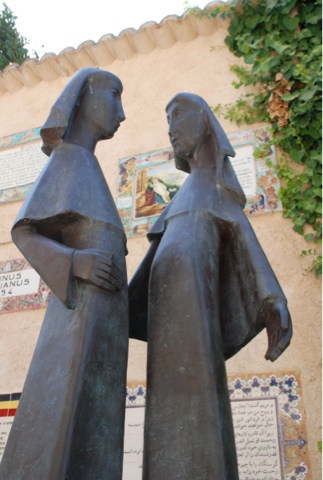
After lunch we got on a bus and headed to Ein Karem, a small village where it is believed that Mary visited her cousin Elizabeth who was pregnant with John the Baptist. We first visited the Church of the Visitation - dedicated to this special encounter. There was a beautiful statue of this meeting out the front together with tiles bearing the magnificat prayer in many different languages. We then went to the church of John the Baptist which had similar tiles bearing Zechariah's prayer for his son John in different languages.
From here we walked up to the Sisters of Sion convent - a haven and place of retreat and reflection- where we had some quiet time then shared a meal together. The highlight of this day was our Mass in honour of Mary in the sisters' chapel- Fr Richard Ross said the Mass which included a beautiful Taize chant of the Magnificat, special prayers and the final hymn - Gentle Woman. It was very moving and I really felt united with all other women both past and present - it was a wonderful celebration of the blessings of womanhood.




• It is important to remember that Jesus, Mary the early disciples and gospel writers were all Jews- so it is important for Christians to learn about the roots of our faith to be found in Judaism
• Ancient and modern Judaism are connected so today's Jews are a link in the chain to the past
• Jews are not exclusively and primarily a religious group - they are a people hood.
• Jews are a people who argue a lot - there is very little they agree on.
I thoroughly enjoyed her lectures and learnt some much about the Jewish culture of the past and today.
After lunch we got on a bus and headed to Ein Karem, a small village where it is believed that Mary visited her cousin Elizabeth who was pregnant with John the Baptist. We first visited the Church of the Visitation - dedicated to this special encounter. There was a beautiful statue of this meeting out the front together with tiles bearing the magnificat prayer in many different languages. We then went to the church of John the Baptist which had similar tiles bearing Zechariah's prayer for his son John in different languages.
From here we walked up to the Sisters of Sion convent - a haven and place of retreat and reflection- where we had some quiet time then shared a meal together. The highlight of this day was our Mass in honour of Mary in the sisters' chapel- Fr Richard Ross said the Mass which included a beautiful Taize chant of the Magnificat, special prayers and the final hymn - Gentle Woman. It was very moving and I really felt united with all other women both past and present - it was a wonderful celebration of the blessings of womanhood.
Thursday, 6 September 2012
The Shema and the Tower of David
"Shema Israel Adonai Elohenu Adonai Ehad"- " Listen, Israel: The Lord our God the Lord is One"
Yesterday we began our first set of lectures about the Bible, with a special focus on the Shema - a key text in Judaism from the book of Deuteronomy which is recited twice a day by male Jews. It is like a creed.The printed text is also kept in plaques on all doorways in Jewish houses. We also had a short introduction to the Old Testament and some background on Matthew's Gospel.
After lunch we walked through the Old city with its maze of cobbled streets and narrow alleyways full of merchants trying to sell you their wares, up to the Tower of David, where in two and a half hours, we were given a summary of the 6000 year history of this ancient land. From the top of the Tower we had a great view over the city out to the Mount of Olives, the Dome of the Rock, where the old temple used to be, and many other significant sites of the city.
The heat of the day got to us so after the tour we went and had a cool drink before making our way to the Church of the Holy Sepulchre - the sight of Calvary. This was the highlight of the day for me - actually visiting Golgotha, the place where it is believed Jesus was crucified. After climbing up the stairs, you can kneel down under an altar and touch the rocks of Calvary. We also went into the tomb where Jesus was buried and where the resurrection occurred. It was very moving to be in this holiest of places and to be silent, still and pray.


Yesterday we began our first set of lectures about the Bible, with a special focus on the Shema - a key text in Judaism from the book of Deuteronomy which is recited twice a day by male Jews. It is like a creed.The printed text is also kept in plaques on all doorways in Jewish houses. We also had a short introduction to the Old Testament and some background on Matthew's Gospel.
After lunch we walked through the Old city with its maze of cobbled streets and narrow alleyways full of merchants trying to sell you their wares, up to the Tower of David, where in two and a half hours, we were given a summary of the 6000 year history of this ancient land. From the top of the Tower we had a great view over the city out to the Mount of Olives, the Dome of the Rock, where the old temple used to be, and many other significant sites of the city.
The heat of the day got to us so after the tour we went and had a cool drink before making our way to the Church of the Holy Sepulchre - the sight of Calvary. This was the highlight of the day for me - actually visiting Golgotha, the place where it is believed Jesus was crucified. After climbing up the stairs, you can kneel down under an altar and touch the rocks of Calvary. We also went into the tomb where Jesus was buried and where the resurrection occurred. It was very moving to be in this holiest of places and to be silent, still and pray.
Subscribe to:
Posts (Atom)